
Agriculture · Environment/Forestry
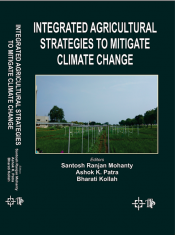
Integrated Agricultural Strategies to Mitigate Climate Change
₹1,795.50₹1,995.00You save ₹199.50
- ISBN
- 9788170197034
- Year
- 2021
- Binding
- Hardbound
- Language
- English
- Total pages
- 158
- Ebook
- Coming soon
About the Book
This book is an exceptionally valuable resource and comes at the moment of greatest need in the context of putting climate change mitigation and adaptation into practice. To minimize global warming and greenhouse gas emission from agriculture this book unveils chapters that define linkage between ecosystem process and global biogeochemical cycles. Microbes few centimeters below ground decide our existence in this earth. These functional microbes contribute and also mitigate atmospheric greenhouse gas. Book opens with chapters highlighting the fundamentals of soil microbial diversity and interaction with climate change. Soil carbon dynamics in response to different agricultural practice has been extensively discussed. A chapter exclusively illustrates the engineering intervention strategies to mitigate greenhouse gas emission from agriculture. Finally it provides quantitative scenarios of climate change mitigation by organic farming, and models predicting agriculture for the formulation of a national strategy for an effective and sustainable set of climate change mitigation measures. Individual chapters will prove invaluable support for agriculture, life science, and environmental planning modules at undergraduate and postgraduate levels. The book suggests different metaphors for the strategic options to make climate change work for us, rather than against us, offering practical solutions to climate change – both adaptation and mitigation.
Integrated Agricultural Strategies to Mitigate Climate Change by S. R. Mohanty, Ashok K Patra and B. Kollah.
158 pages · English · Published 2021
Subjects: Agriculture, Environment/Forestry
About Author
Dr. Santosh Ranjan Mohanty is currently Principal Scientist at the Indian Institute of Soil Science, Bhopal actively involved in research in the field of greenhouse gas (GHG) and climate change microbiology. He is actively involved in this field of research since 1995. During his early carrier he worked on GHG emission and mitigation from rice field ecosystem. His research highlighted methane (CH4) cycling process in different agricultural ecosystem and contributed identifying the best agricultural strategies minimizing atmospheric methane emission from rice field ecosystem. Dr. Mohanty received many prestigious awards, international fellowships, and research experiences. He worked as post doctoral research fellow at the Max planck institute for terrestrial microbiology, Germany during 2001- 2003. Later he joined in US dept of Energy funded project as Assistant research scientist at the University of Alabama, USA during 2003-2005. His research developed bioremediation process for the removal of uranium from subsurface contaminated soil. Later he continued his research at the Univ of Wisconsin, Madison, USA during 2005-2008. Subsequently, he was appointed as academic faculty during 2008-2009, at the University of Wisconsin Stout, USA and served to teach molecular biology and cell biology. He received the young investigator award from India bioscience and eminent scientist award from National environmental science academy. He is also a Fulbright fellow 2019. He has published 45 international, 9 national research articles and has successfully guided 10 students for MSc/M. Phil. degree.
Dr Ashok K Patra is the director of Indian institute of soil science, Bhopal. He is the recipient of prestigious awards including British Council TCT Award; DBT Overseas Associateship Award; FAI Dhiru Morarji Memorial Award; Rajiv Gandhi Excellence Award; Hooker Award, 2013; Bioved Agri-innovation Award; International Plant Nutrition Institute (IPNI)-FAI Award; He served as editor of Range Management and Agroforestry; Journal of the Indian Society of Soil Science; Associate Editor of European Journal of Soil Science etc. He was the member of Intergovernmental Technical Panel on Soils (ITPS) of FAO, Rome; President, Indian Society of Soil Science. He is also recognized as one of the 13 soil researchers worldwide advancing soil science (Food Tank, USA).
Dr Bharati Kollah is Principal Scientist at the Indian Institute of Soil Science. She started her carrier as research fellow at the central rice research institute in IRRI-UNDP funded project. She carried out several experiments and published several research articles on greenhouse gas (GHG) emission from rice based cropping system. She completed her PhD in 2001 and joined as researcher at National physical laboratory (NPL), N Delhi. Dr Bharati joined the Forschung zentrum, Juelich, Germany during 2002-2003 to explore fate of GHG in atmosphere through simulation. Subsequently she joined at the Univ of Alabama, Tuscaloosa, USA as research scientist during 2003-2005. There she was part of the team exploring fate of radionuclide in the subsurface sediments. Subsequently she continued her research on uranium bioremediation at the Univ of Wisconsin, Madison, USA from 2005-2008. Currently she is working in projects to monitor GHG cycling process during manure composting and process of pesticide degradation under changing climate condition. She has published more than 25 international publications and has received awards like DBT Biocare award.
Content
�Fundamentals of microbial diversity, and ecosystem Function. �Conservation Agriculture to Enhance Soil Microbial Diversity. �Soil Organic Carbon for Eco-System Functioning and Soil Health. �Mitigation of Atmospheric Greenhouse Gasses Through Different Agricultural Practices. �Elevated Atmospheric Temperature and Carbon Dioxide: Effect on Soil Biota and Microbial Diversity. �Soil Carbon Sequestration and Framing the Limits of Carbon in Soil Types. �Soil Microbial Diversity and Organic Matter Decomposition. �Soil Organic Carbon dynamics in Long Term Fertilizer Experiment and Methodology to Calculate Minimum Amount of C Required to Maintain Thresh Hold Level. �Climate Change in Relation to Emissions of Green House Gases and Land use Change, and Mitigation Opportunities. �Plant Physiological Responses to Elevated CO2 and Temperature. �Importance of Soil Testing in Soil Health Assessment and Improvement. �Organic Farming: Carbon Sequestration in Tropical Agro-eco Systems. �Greenhouse Gas Contributions from Agriculture: Potential Mitigation Strategies Through Simulation Modelling.
Similar books

Agriculture · Environment/Forestry
Sustainable Solutions: Navigating Climate Change and Natural Resources
₹2,965.50₹3,295.00
Book details for Sustainable Solutions: Navigating Climate Change and Natural Resources

Agriculture · Anthropology/ Minorities/ North East/ Tribal Studies · Environment/Forestry · Social Sciences
Mizoram Environment, Development, and Climate Change
₹2,245.50₹2,495.00
Book details for Mizoram Environment, Development, and Climate Change

Agriculture · Botany
Pollen Biology, Biodiversity and Climate Change
₹2,965.50₹3,295.00
Book details for Pollen Biology, Biodiversity and Climate Change

Agriculture · Botany · Soil Sc./Agronomy
Climate Change : Impacts and Adaptations in Crop Plants
₹2,966.00₹3,295.00
Book details for Climate Change : Impacts and Adaptations in Crop Plants

Agriculture · Geology & Geography · Environment/Forestry · Plant Pathology
Climate Change and Socio-Ecological Transformation
₹2,696.00₹2,995.00
Book details for Climate Change and Socio-Ecological Transformation

Agriculture · Botany · Fisheries Science · Plant Pathology
Integrated Approaches for Stored Product Protection
₹4,135.50₹4,595.00
Book details for Integrated Approaches for Stored Product Protection

Agriculture · Entomology · Fisheries Science
Diagnosis and Green Perspectives in the Management of Agricultural Pests
₹3,595.50₹3,995.00
Book details for Diagnosis and Green Perspectives in the Management of Agricultural Pests